
From Pilot to Production: The CTO's Playbook for AI That Actually Ships
We are living through a gold rush of sandbox demos.
Walk into any enterprise boardroom in 2026, and you will witness a familiar spectacle: a team of enthusiastic developers presenting an AI pilot. The chatbot answers questions, summarizes documents, and perhaps even writes a simple script. The board is impressed, the project is greenlit, and another pilot program is heralded as a triumph of corporate innovation. But look closer at these pilots, and you will find they are built on sand. They are fragile, prompt-engineered structures running on raw, unconstrained APIs, with no guardrails, no latency guarantees, and no predictable cost structure.
This is the sandbox trap. According to recent industry benchmarks, more than 90% of enterprise AI pilots fail to make the transition to production-grade software. They remain trapped in a perpetual state of proof-of-concept, draining engineering resources and accumulating massive technical debt.
To bridge this gap, engineering leaders must shift their focus from the magic of LLM capabilities to the rigor of system architecture. Shipping AI that actually works requires killing the demo hype, establishing strict operational boundaries, and enforcing deterministic governance.
The Non-Deterministic Challenge
The primary reason AI pilots fail in production is that they violate the fundamental assumption of traditional software engineering: determinism.
Traditional software is predictable. If you pass input A to function B, you will always get output C. If the output changes, it is a bug that can be traced, debugged, and fixed. AI systems, by contrast, are inherently probabilistic. They do not calculate outputs; they predict the next most likely token based on statistical weights. The same input passed to the same model twice can yield different outputs, depending on temperature, context window size, and random seed drift.
This non-determinism introduces unique, systemic failure modes:
Semantic Drift: Over time, as user prompts shift and models are updated or fine-tuned, the quality and format of the outputs can drift, breaking downstream APIs that expect structured data.
Prompt Vulnerabilities: Without strict input validation, systems are vulnerable to prompt injection attacks, where users bypass system instructions to extract private weights or trigger unauthorized actions.
Hallucination Cascades: In multi-agent systems, a single hallucinated value from one agent can be ingested by the next, magnifying the error until the entire workflow collapses.
Treating a probabilistic model as if it were a deterministic library is a recipe for system-wide failure. The role of the CTO is not to eliminate non-determinism—which is impossible—but to build a deterministic perimeter around the probabilistic core.
Designing Agentic Boundaries
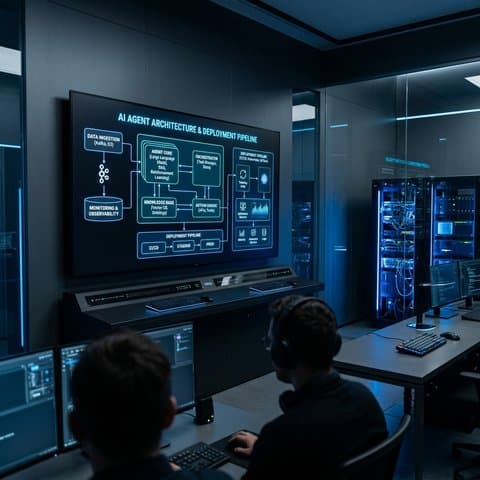
To run AI reliably in production, we must separate the cognitive engine from the execution layer. We must design architectures where the LLM is treated as an untrusted, advisory component, rather than a direct controller of system state.
This is the foundation of Container-First Agentic Architecture. In this model, the AI agent does not write to the database or call external APIs directly. Instead, it generates a structured, declarative intent (usually in JSON format) which is then parsed, validated, and executed by a deterministic microservice.
The deterministic gate acts as a semantic validator. It checks the JSON payload against a strict schema, verifies that the requested action is within the user's authorization boundaries, and sanitizes any inputs. If the agent generates a malformed payload or attempts an invalid operation, the gate rejects the request and triggers a fallback mechanism.
In practice, this validation layer is built using runtime parsing tools such as Zod or Pydantic. When the model output fails validation—such as when it omits a required field or returns a string instead of an expected array—the system should not crash or return a generic error. Instead, the middleware must execute a localized self-correction loop. The validation error is fed back to the model as a system correction prompt (e.g., "Your output failed JSON Schema validation because the field 'id' is missing. Please regenerate the JSON payload keeping this field in place."). To prevent infinite token consumption and latency spikes, this micro-retry loop must be capped strictly at two attempts. If the model fails to self-correct within these bounds, the system automatically triggers a fallback path using deterministic heuristics.
The gold rule of production AI: Never let a model touch a production database without a schema-validating gatekeeper.
By enforcing this separation of concerns, we isolate the non-deterministic behaviors of the model. If the agent drifts or hallucinates, the error is caught at the boundary, preventing it from corrupting the system of record or creating security breaches.
The Metrics That Matter: Latency, Cost, and SLAs
In the sandbox, developers care about model accuracy and benchmark scores like MMLU or GSM8k. In production, these academic metrics are secondary. The metrics that decide whether an AI system survives are operational: latency, cost per inference, and Service Level Agreement (SLA) compliance.
Consider the reality of enterprise SLAs. If a user-facing application requires a sub-second response time, deploying a 70-billion-parameter model that takes 5 seconds to generate a response is a non-starter, no matter how accurate its answers are. Similarly, if the cost of running an AI-powered query exceeds the customer's subscription value, the system is economically unviable.
To build an operationally sustainable system, CTOs must optimize for three core parameters:
Time-to-First-Token (TTFT): The latency between the user request and the first character generated. This is critical for perceived user experience.
Tokenomics (Input/Output Ratios): Minimizing the size of the system prompt and history to reduce context window costs and processing time.
Routing Optimization: Dynamically directing queries to the smallest, cheapest model that can successfully execute the task.
By implementing a hybrid routing strategy, we can send simple queries (e.g., entity extraction) to a local, lightweight 8-billion-parameter model, while reserving expensive frontier models only for complex, multi-step reasoning tasks. This reduces the average cost per query by orders of magnitude and brings overall system latency within acceptable enterprise boundaries.
The CTO's Deployment Playbook
Transitioning AI to production requires updating our traditional CI/CD pipelines to accommodate the unique lifecycle of models. Prompts, weights, and system instructions must be treated with the same version control and testing rigor as application code.
The following steps define the production playbook for engineering leaders:
1. Version Prompts as Code
Never hardcode prompts in application code or allow them to be edited dynamically in a database. Prompts must be stored in version-controlled repositories, subjected to code reviews, and deployed via standard CI/CD pipelines. Every change to a prompt must be treated as a potentially breaking API modification.
2. Implement Automated Regression Testing
Before a new prompt or model version is pushed to production, it must be run against an automated test suite containing hundreds of historical user inputs. The outputs must be evaluated programmatically for format compliance, semantic accuracy, and regression anomalies using LLM-as-a-judge patterns.
3. Establish Local Fallbacks
Never design a system that relies entirely on a single cloud-based API. If the external provider experiences an outage or latency spike, your system must degrade gracefully. This means having local, self-hosted Small Language Models (SLMs) running on sovereign infrastructure, ready to take over critical tasks with lightweight heuristics.
4. Build Real-Time Monitoring and Observability
Deploy tracing frameworks that log every step of an agentic chain. You must be able to trace exactly which prompt led to a specific LLM response, how much it cost, how long it took, and what actions it triggered. Observability is the only way to debug semantic drift and diagnose performance bottlenecks in production.
Reclaiming the ROI
The ultimate goal of this playbook is to rescue AI from the domain of performative technology. We must move past the era of "AI washing"—where companies add basic chat interfaces to legacy systems simply to show shareholders they are participating in the trend.
True return on investment comes from automating deep, operational workflows using highly optimized, specialized agent networks. By building boundaries-first systems, enforcing strict SLAs, and treating model integration as an engineering discipline rather than an academic research project, we can build software that is robust, maintainable, and economically sustainable.
The era of the sandbox demo is closing. The future belongs to the engineering teams who know how to ship.
This article is a response to Aiko Tanaka's analysis of corporate AI efficiency in [The AI ROI Reckoning](https://soogus.com/p/the-ai-roi-reckoning-what-the-numbers-actually-say).