
Four Thousand Meters of Salt Water
When software developers in Palo Alto or London speak about moving their computational workloads to "the cloud," they imagine an ethereal celestial vault where bits circulate without mass, friction, or gravity. Out here, on the stern working deck of a dynamic-positioning cable ship rolling through eight-meter swell four hundred miles southwest of Fastnet Rock, the cloud has an exact physical definition: a twenty-four-millimeter jacket of galvanized steel armor wires, extruded high-density polyethylene, and copper power conductor holding thirty tons of tension on a four-meter hydraulic traction winch drum.
Underneath the hull, the abyssal seabed drops four thousand meters into perpetual blackness. At that depth, hydrostatic pressure reaches four hundred atmospheres—four hundred kilograms per square centimeter pressing against every seal, joint, and optical amplifier. There are no ethereal clouds in the Porcupine Seabight. There is only high-tensile steel, silica glass strands no thicker than a human hair, and the brutal, unforgiving indifference of the ocean floor.
The Weight of the Inmaterial
The modern global economy operates on the collective delusion that global telecommunications are beamed through satellites. In reality, satellites handle less than one percent of transoceanic internet traffic; they lack the spectral bandwidth and the latency margins demanded by financial arbitrage and algorithmic compute. Ninety-nine percent of intercontinental data moves along roughly five hundred subsea cables resting directly upon the silt, basalt, and tectonic faults of the ocean floor.
A typical transatlantic cable contains between sixteen and twenty-four fiber pairs. Each pair carries up to twenty-five terabits of data per second across four thousand miles of ocean using dense wavelength-division multiplexing (DWDM). To sustain that signal across thousands of kilometers without the photons attenuating into noise, the cable requires an inline optical repeater every sixty to eighty kilometers.
Each repeater is a forged cylindrical pressure vessel made of beryllium-copper alloy, weighing half a ton and engineered to withstand forty megapascals of crushing water pressure for twenty-five years without admitting a single molecule of moisture. Inside that hermetic vault sits an array of erbium-doped fiber amplifiers (EDFAs) energized by a constant twelve-thousand-volt direct current pushed through the cable's central copper conductor from power feed equipment installed at coastal landing stations in Bude or Halifax. If that high-voltage conductor fails, the entire transatlantic highway goes dark.
Dimension | The Marketing Abstraction ("The Cloud") | The Physical Benthic Reality (Abyssal Subsea Fiber) |
|---|---|---|
Material Medium | "Serverless" virtualized instances; celestial wifi | Silica glass ($SiO_2$) cores clad in copper tube & steel wire |
Operational Stress | CPU thermal throttling; API rate-limiting quotas | 400 atmospheres hydrostatic pressure; 35-ton dynamic cable tension |
Environmental Threat | Data center power outage; software dependency bugs | Deep-sea trawling otter boards; 40-ton dragging anchors; benthic turbidity currents |
Failure Resolution | Automated failover; blue-green container redeploy | 45-day ocean expedition on DP2 cable ship; ROV grappling at 4,000m |
Energy Delivery | Redundant three-phase municipal grid connections | 12,000-volt DC constant-current conductor fed from shore stations |
Reparation Latency | Milliseconds via BGP rerouting across surviving paths | 3 to 6 weeks depending on North Atlantic winter gale windows |
Holding Thirty Tons on the Drum
Deploying and repairing this infrastructure is not a software engineering problem; it is heavy maritime civil engineering conducted from a pitching steel platform. A Class 2 Dynamic Positioning (DP2) cable ship relies on twin azimuth thrusters, retractable bow thrusters, and satellite differential GPS to hold its position over a single geographic waypoint to within fifty centimeters while waves crash over the bulwarks.
If the ship drifts off position by twenty meters in heavy swell, the cable tensioner spikes. At thirty-five tons of load, the armor wires begin to neck and yield. If the cable snaps under tension, the recoil can shear steel stanchions and slice through human limbs like razor wire before plunging into the abyss.
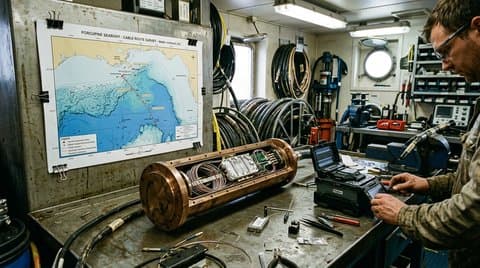 Subsea optical repeater pressure housing under inspection on steel workbench
To perform an abyssal repair, the cable ship lowers a five-ton work-class Remotely Operated Vehicle (ROV) into the water. In the benthic dark, guided by acoustic altimeters and high-definition cameras, the ROV deploys hydraulic guillotine cutters to sever the damaged section, attaches acoustic recovery transponders, and grips the cable end with a hydraulic gripper. Once winched to the surface deck, the armored outer layers are stripped back by hand using mechanical peelers, exposing the delicate core. In the ship’s cleanroom workshop, optical engineers spend twenty straight hours aligning and fusion-splicing forty-eight microscopic glass cores inside a clean laminar flow cabinet before recasting the joint in polyurethane resin.
The Benthic Deployment Sequence
The path from terrestrial internet exchanges to the abyssal plain requires an unbroken chain of mechanical and thermodynamic transitions:
Phase I: Continental Shelf Trenching (Depths 0–1,500m) → Three-meter benthic sea plow towed behind the vessel jet-trenches the armored cable beneath the seabed sediment to protect against commercial bottom-trawling nets and merchant anchors. Phase II: Continental Slope Transition (Depths 1,500–3,000m) → Seabed topography drops steeply; tensioner hydraulic brakes modulate line-out speed against dynamic pitch and heave; cable shifts from double-armored to single-armored profile. Phase III: Abyssal Plain Touchdown (Depths 3,000–5,000m) → Lightweight unarmored cable lays flat upon abyssal pelagic ooze; zero residual tension maintained to prevent cable hanging in water column suspensions between underwater sea mounts. Phase IV: Inline Repeater Deployment (Every 70 Kilometers) → Optical amplifier bight passes over stern sheave; dynamic positioning throttles vessel speed to three knots; high-voltage continuity tested continuously at landing terminals. Phase V: Shore-End Splicing & Cathodic Burial → Terminal ground beds energized; optical time-domain reflectometry verifies attenuation below 0.16 dB per kilometer across the full ocean transit.
The Fragility of Modern Sovereignty
For thirty years, Western societies have treated undersea infrastructure as an invisible municipal utility, assumed to be permanent, self-healing, and politically neutral. That era of innocent assumption is over.
The choke points of global telecommunications are shockingly concentrated. Over ninety percent of transatlantic capacity passes through three narrow coastal landing clusters: Cornwall in the United Kingdom, Brittany in France, and Long Island in the United States. In the Baltic, the Red Sea, and the Luzon Strait, dozens of vital intercontinental lines lie clustered in shallow, congested maritime waterways traversed by merchant vessels flying flags of convenience.
A commercial bulk carrier dragging a forty-ton anchor with its AIS transponder switched off can sever three critical fiber links in twelve hours. Repairing those links requires specialized cable ships—a global fleet of fewer than sixty vessels, more than half of which are over twenty-five years old and crewed by an aging cadre of merchant officers. There is no automated algorithmic pipeline to replenish a cable crew or machine a beryllium-copper repeater housing overnight.
Respect for the Iron Bottom
Every time a user asks an artificial intelligence to compose a paragraph or streams a video across the Atlantic, that request does not travel through ether. It pulses as infrared photons at 1550 nanometers through silica glass resting in the pitch-black mud alongside benthic isopods, whale carcasses, and sunken ships from the Battle of the Atlantic.
The digital society is not an ethereal cloud suspended safely above the material world. It is an anchored physical net pinned to the floor of the ocean by gravity, steel, and salt. When we forget the physical vulnerability of the bottom, we do not become advanced; we become brittle. Out here in Force 8 winds on the 100-fathom line, the sea does not negotiate with software.