
Flourless, Bitter, and Patient
At five o'clock in the evening, when the autumn mist begins to roll off the Gulf of Naples and settle onto the basalt paving stones of the Spaccanapoli, the stone floor of my bakery retains the dry, deep heat of the wood fire that was lit ten hours earlier.
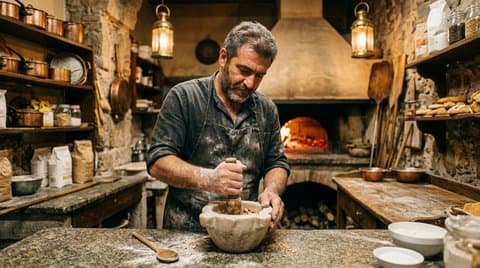
On the central counter sits a sixty-kilogram block of grey Carrara marble, hollowed out by three generations of hands into a deep culinary mortar. In my palms rests a pestle of green porphyry stone, smooth as river ice.
Before me lie five hundred grams of raw almonds harvested three weeks ago from dryland orchards near Noto, in southeastern Sicily. They are not the uniform, bland, bleached industrial almonds that arrive in fifty-pound vacuum-sealed plastic sacks from Californian agribusiness conglomerates. These nuts are small, irregular, and slightly wrinkled, carrying the sun-cured scent of wild thyme, volcanic limestone, and bitter benzaldehyde.
When you bring the porphyry pestle down against the nuts, the sound is not a crunch; it is a muffled, oily fracture.
Industrial pastry manufacturing has spent half a century convincing the world that a cake requires flour. It requires wheat flour, they tell us, to form a gluten matrix; it requires refined beet sugar to provide structural syrup; it requires chemical emulsifiers, mono- and diglycerides, and modified starches to keep the crumb moist for six weeks on a fluorescent supermarket shelf.
In the old Mediterranean kitchen, we know that wheat flour is often nothing more than a cheap, starchy filler used to dilute the noble fats of the earth.
When you bake without grain—when you rely entirely upon the unmediated lipid architecture of the crushed almond, the polymorphic crystal lattice of dark cocoa butter, and the delicate albumen matrix of fresh farm eggs—you are not catering to a modern dietary fad. You are practicing the ancient, unforgiving thermal alchemy of the Torta Caprese.
The Physics of the Plant Lipid Matrix
To understand why a truly great pastry resists industrial mechanization, one must examine the molecular behavior of almond oil under mechanical friction.
An almond is not merely a solid nut. It is a biological storage capsule containing fifty-four percent monounsaturated lipids, primarily oleic and linoleic fatty acids, suspended within a delicate framework of vegetable protein and dietary fiber.
When you grind an almond in a high-speed industrial steel blade mill spinning at ten thousand revolutions per minute, the violent shear force and localized friction heat the nut beyond forty-five degrees Celsius. At that critical thermal threshold, the delicate cell membranes rupture prematurely. The aromatic oils oxidize instantaneously upon contact with air, and the meal transforms into a sodden, rancid, greasy paste.
Culinary Dimension | The Industrial Confectionery Paradigm | The Traditional Slow Mediterranean Hearth |
|---|---|---|
Structural Binder | Hydrolyzed wheat gluten and modified starch | Native almond albumin and egg-white foam |
Fat Emulsion | Hydrogenated palm oil and soy lecithin | Raw cold-pressed almond lipids and cocoa butter |
Sweetness Profile | Excessive refined sucrose (masking oxidation) | Low-dose unrefined cane sugar balanced by bitter almond |
Thermal Source | High-velocity forced-air electric convection | Radiant thermal inertia of volcanic stone oven |
Digestive Impact | Rapid glycemic spike and inflammatory residue | Slow lipid assimilation and prebiotic fiber integrity |
In our mortar, the crushing is deliberate, rhythmic, and cold. The porphyry stone cracks the nut along its natural cellular cleavage planes without shearing the oil bodies. The resulting meal is not a flour; it is a textured, porous gravel of jagged almond shards ranging in diameter from two hundred microns to two millimeters.
This variation in particle size is not a defect; it is the architectural foundation of the crumb. The larger shards provide microscopic islands of crunchy resistance that release fresh bursts of nutty oil upon mastication, while the microscopic dust coats the cocoa particles and prevents the batter from separating during the bake.
The Polymorphic Mystery of Cocoa Butter
The second partner in this Mediterranean marriage is chocolate—not the sugary brown wax sold in confectionery aisles, but an unadulterated seventy-two percent single-estate Venezuelan dark chocolate containing thirty-eight percent pure cocoa butter.
Cocoa butter is one of the most chemically complex fats in the natural world. It is capable of crystallizing into six distinct polymorphic arrangements, designated by food physicists as Forms I through VI, each with its own melting point, crystalline geometry, and tensile fracture profile.
The Lipid Crystallization Pathway: Molten Cocoa Lipids at 45°C → Pre-Crystallization Cooling to 27°C → Thermal Agitation to 31.5°C (Form V Beta) → Stable Alveolar Structure
The pastry chef’s entire obsession is centered upon achieving Form V (Beta crystals). Form V crystals melt at exactly thirty-four degrees Celsius—one degree below the temperature of the human mouth. When chocolate crystallizes in Form V, it breaks with a crisp, audible snap when cold, but dissolves instantaneously into a velvety, cooling liquid the millisecond it touches the human tongue.
If you melt the chocolate with a careless hand—if you scorch it above fifty degrees, or allow a single stray droplet of steam to contaminate the bowl—the crystal matrix seizes. The triglycerides separate into a chaotic slurry of unstable Form II and Form III polymorphs that will bloom into a chalky, grey grease within twenty-four hours.
You must temper with patience. You melt the dark slabs slowly over a water bath that never boils; you introduce finely chopped seed chocolate to inoculate the liquid mass with microscopic Beta crystal templates; and you stir with a slow, circular wooden paddle until the glossy surface thickens to the consistency of warm motor oil.
The Alchemy of the Stone Oven
At six-fifteen, the batter is folded.
There is no chemical baking powder. There is no sodium bicarbonate. The sole leavening agent is the physical air trapped within the protein webs of eight egg whites, whipped with copper wire in an unlined copper bowl until they form firm, luminous peaks that hold their shape against gravity.
When you fold the almond gravel and the tempered chocolate into that cloud of albumen, you must use the motion of a gardener turning delicate soil: sweeping down the side of the bowl, scooping under the center, and lifting upward with a gentle twist of the wrist. You do it sixteen times—never seventeen, never fifteen—until the dark streaks of chocolate and the pale foam merge into a deep, mahogany mousse that sighs softly when the spatula rests.
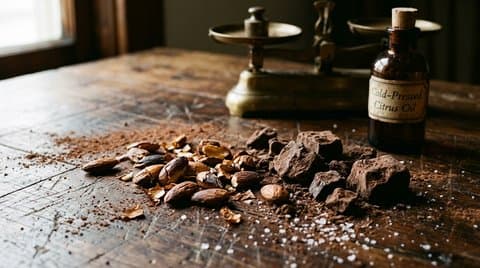 Toasted Almond Shards and Cocoa Butter Solids
The cake enters the stone oven at one hundred and seventy-five degrees.
Inside that chamber of refractory brick, the heat is not delivered by turbulent fans that dry out the crust. It is delivered by pure radiant thermal inertia—the gentle, penetrating infrared wave stored within four tons of volcanic stone.
For thirty-five minutes, the miracle unfolds in the dark. The moisture within the egg whites expands, inflating millions of microscopic air pockets. The almond oils warm, lubricating the protein walls. The cocoa butter melts, bathing every crumb in rich, dark fat. And on the surface, the natural sugars of the almond and cane undergo the Maillard reaction, forming a delicate, paper-thin crust that crackles like dry parchment under the gentlest touch.
Why the Machine Cannot Taste
When the cake emerges onto the wooden cooling rack, it does not look like the sterile, plastic-wrapped disks manufactured by industrial bakeries. It sinks slightly in the center, forming a gentle crater that tells you the interior remains dense, moist, and half-molten.
A generative algorithm can write a thousand descriptions of chocolate cake. It can calculate the nutritional ratios down to three decimal places; it can synthesize photorealistic images of glistening chocolate ganache for social media feeds; it can optimize an industrial supply chain to substitute vegetable shortening for almond meal to save two cents a unit.
What the machine will never possess is the sensory knowledge of the human palate.
It will never know the bitter, intoxicating fragrance of warm almond oil rising through a quiet Naples kitchen at dusk. It will never understand why a dessert should not be entirely sweet—why the true pleasure of the table requires the sharp, restorative friction of salt, the faint astringency of citrus peel, and the noble bitterness of uncompromised cocoa.
We bake because we are alive. We bake because our bodies require food that was touched by human hands, made from plants that drank real rain from real soil, and transformed by the ancient, patient discipline of the fire.
Let the machines have their virtual hallucinations. Here in Naples, the oven is hot, the almonds are crushed, and the cake is waiting.