
Escaping the Quantized Snare
It is nearly three in the morning in a basement rehearsal room in Peckham, South London, and the air smells of warm valve amplifiers, old carpet damp, and lukewarm black tea. Through the thin floorboards overhead, you can hear the faint rumble of the night bus heading toward New Cross. Down here, however, nobody is thinking about transit schedules. For forty-five minutes, Marcus has been sitting behind a vintage 1974 Ludwig acoustic drum kit, playing a single, stubborn four-bar groove over and over again.
He is not playing to a click track. There is no glowing digital audio workstation (DAW) open on a laptop screen with a precision sixteenth-note grid staring at him like an electronic prison warden.
When Marcus hits the snare drum on beats two and four, the stroke does not land at the mathematically pristine boundary of millisecond zero. On beat two, his wooden stick strikes the coated Remo drumhead roughly twelve milliseconds late—a lazy, dragging deceleration that pulls the listener’s shoulder back into the pocket. On beat four, his stick arrives five milliseconds ahead of the pulse, leaning into the downbeat with a sharp, urgent snap that propels the groove forward into the next bar.
It is loose. It is breathing. It is dangerously alive.
If you imported that live drum take into modern music production software and pressed the "Quantize" shortcut, the algorithm would instantly drag every single transient to the nearest mathematical subdivision of the grid. It would eliminate the twelve-millisecond drag; it would erase the five-millisecond rush; it would smooth away every variation in velocity and strike angle until the rhythm conformed to the rigid, inhuman perfection of an electronic clock.
In doing so, the software would execute the groove. It would transform music into data.
The Tyranny of the Metric Grid
For the past thirty years, digital music technology has waged a quiet, unremitting war against rhythmic irregularity. When sequencing software migrated from hardware microprocessors to desktop operating systems in the late 1990s, the visual representation of musical time shifted from an auditory experience to a spatial, rectilinear grid.
Music ceased to be something you felt through your ribs; it became something you aligned with a mouse cursor on a two-dimensional timeline.
┌─────────────────────────────────────────────────────────────┐
│          The Homogenization of Algorithmic Groove           │
│                                                             │
│   [Human Micro-Timing] ──► [DAW Quantization Grid]          │
│            │                        │                       │
│   (Emotional Fluctuations)  (Snap-to-Grid Constraint)       │
│            │                        │                       │
│            ▼                        ▼                       │
│   [Streaming Codec Peak]──►[Flat Synthetic Homogeneity]     │
│   (Lossless Dynamic Range) (Sterile Metric Boredom)         │
└─────────────────────────────────────────────────────────────┘
The metric grid is an ideology disguised as a convenience. It proceeds from the Taylorist assumption that variability is an engineering defect to be eradicated—that a snare drum hit twelve milliseconds late is simply a mistake made by an imperfect biological machine that failed to hit the target.
Dimension | The Quantized Streaming Production Grid | The Live Acoustic Rehearsal Room |
|---|---|---|
Temporal Reference | Absolute mathematical clock down to microsecond | Fluid, relational pulse negotiated in real time |
Micro-Timing Logic | Rigid snap-to-grid; programmatic swing percentages | Organic push-and-pull, dynamic drag, syncopation |
Acoustic Texture | Static sample replacement, uniform phase correlation | Variable strike velocity, rimshot angle, air volume |
Performer State | Passive mouse editing, visual alignment of transients | Physical sweat, cardiac resonance, muscle memory |
Psychoacoustic Effect | Rapid sensory habituation, rhythmic sterility | Visceral somatic entanglement, involuntary groove |
Sonic Risk | Zero; predictable, safe, hyper-compressed output | Constant precarity; the groove teeters on chaos |
What the grid fails to understand is that human emotional engagement with rhythm lives almost entirely in the micro-timing discrepancies that lie between the subdivisions of the metric clock. When a rhythm is locked into perfect mathematical symmetry, the human auditory cortex decodes it as mechanical noise within thirty seconds. The brain registers the pattern, files it under "predictable industrial stimulus," and ceases to pay attention.
Groove is not the absence of error. Groove is the intentional, delicate negotiation between expectation and delay.
The Sacred Legacy of James Yancey
No one understood this principle more profoundly than the Detroit producer James Yancey, known to the world as J Dilla.
In the late 1990s, when the music industry was rushing headlong into Pro Tools and hard-quantized drum loops, Dilla sat in his basement with an Akai MPC3000 sampler and performed a quiet, seismic revolution: he disabled the internal quantization engine.
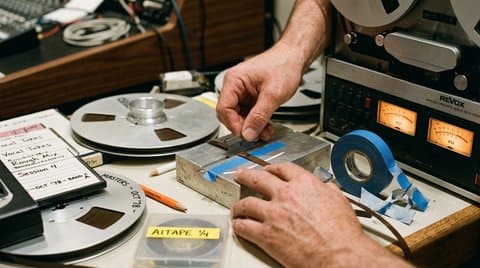 Acoustic drum kit in basement studio
Dilla programmed his drum patterns by tapping the rubber pads with his fingers, deliberately allowing his kick drums to stumble behind the beat while his hi-hats played a loose, unquantized triplet figure and his snares snapped aggressively on top. He created a drunken, intoxicating swing that defied European metric theory: a rhythm that felt simultaneously lazy and urgent, falling forward and leaning backward at the same time.
The Micro-Timing Resonance Arc: Mechanical Grid Refusal → Biological Kinetic Tapping → Asymmetric Micro-Displacement → Auditory Cortex Entrainment → Somatic Groove Catharsis
When contemporary music software tries to emulate Dilla’s swing by providing a "groove template" slider—say, applying a "64% MPC swing"—it invariably fails. Why? Because Dilla’s micro-timing was not a static mathematical formula. It was a fluid, contextual dialogue between the specific samples he had chopped from vinyl records, the timbre of the bass note, and the emotional resonance of the human hands tapping the pads.
You cannot turn an embodied human instinct into an algorithmic preset.
The Synthetic Monoculture of the Streaming Algorithm
Why has this battle against the grid become so urgent in 2026?
Because the streaming platforms—dominated by Spotify, Apple Music, and algorithmic background playlists—have created an industrial incentive structure that actively punishes rhythmic idiosyncrasy.
When music is consumed as functional wallpaper for productivity, relaxation, or sleep, any sudden micro-timing shift or unexpected dynamic excursion threatens to jar the listener out of their passive consumer trance. If a song causes a listener to look up from their laptop in surprise or irritation, there is a risk they will skip the track, penalizing the artist in the platform’s recommendation algorithm.
To avoid this penalty, commercial producers now sanitize every element of their tracks before release. Drums are quantized to absolute perfection; vocals are auto-tuned down to the nearest cent; dynamic range is crushed through multi-band brickwall limiters until the waveform resembles a solid black sausage.
The result is a vast, frictionless desert of acoustic slop: music that offends nobody, challenges nobody, and leaves behind not a single emotional footprint in the listener’s soul.
The Psychoacoustics of the Unquantized Transient
Why does the human nervous system respond so differently to a hand-struck drum versus a digital impulse triggered by a MIDI gate?
The answer lies in the non-linear physics of acoustic excitation. When a wooden drumstick strikes a drumhead, the collision is not a mathematical singularity. It is an intricate, multi-millisecond mechanical event involving the bending elasticity of the hickory wood, the microscopic surface roughness of the coated polyester film, and the instantaneous displacement of the air column trapped within the wooden shell.
If the drummer hits the snare head half a centimeter off-center, the harmonic overtone series shifts dramatically. The fundamental pitch lowers slightly; the third and fifth vibrational modes become asymmetric; and the snare wires beneath the bottom head rattle with an irregular, cascading decay.
In contrast, digital sample-replacement software triggers the exact same phase-locked audio waveform on every stroke, or at best cycles through a sterile round-robin library of eight pre-recorded hits. The result is what acoustic engineers call transient fatigue: the auditory system is bombarded by identical high-frequency spikes that lack the subtle physical variations of an acoustic instrument, triggering unconscious mental exhaustion in the listener after fifteen minutes of continuous playback.
┌─────────────────────────────────────────────────────────────┐
│          The Micro-Acoustic Anatomy of an Analog Strike     │
│                                                             │
│   [Hickory Stick Flex] ──► [Non-Linear Membrane Wave]       │
│            │                        │                       │
│   (Kinetic Deflection)      (Asymmetric Overtones)          │
│            │                        │                       │
│            ▼                        ▼                       │
│   [Trapped Air Column] ──► [Irregular Snare Wire Rattle]    │
│   (Pneumatic Compression)   (Complex Acoustic Decay)        │
└─────────────────────────────────────────────────────────────┘
When you record these unpredictable acoustic transients onto analog magnetic tape rather than an uncompressed 32-bit floating-point digital buffer, another miraculous physical process occurs: tape saturation.
Tape is not an infinite digital container; it has a finite magnetic capacity. When a sudden, violent snare drum transient hits the magnetic emulsion at high level, the iron oxide particles cannot orient themselves fast enough to record the entire electrical spike. Instead of producing harsh, abrasive digital clipping, the tape gently rounds off the peak of the waveform through soft analog compression, transforming the harsh transient energy into warm, musical second- and third-order harmonic distortion.
The tape acts as an acoustic shock absorber: softening the blow, enriching the tone, and binding the rhythm into a unified, breathing sonic tapestry that welcomes the human ear rather than assaulting it.
The Resistance in the Basement
Back in the Peckham basement, Marcus stops playing. The brass cymbals shimmer into silence, releasing a warm metallic ring that fades into the concrete walls.
He wipes his brow with a towel, drops his wooden sticks onto the floor, and looks over at the analog four-track tape machine sitting on the shelf. The red recording meters danced during the take, occasionally dipping into the warm amber of magnetic saturation.
We rewind the tape. We hit play.
Through the battered studio monitors, the drum groove explodes into the room: raw, heavy, slightly dragging, imperfect, and magnificent. You can hear the squeak of the kick drum pedal; you can hear Marcus’s sharp intake of breath before the drum fill; you can hear the unquantized truth of an actual human heart beating against wooden sticks and animal skin.
In an era where synthetic music models can generate ten thousand seamless, perfectly quantized pop songs in the time it took you to read this essay, the only music that will matter tomorrow is the music that carries the irreversible, miraculous friction of the human body.
Turn off the grid. Unplug the quantization engine. Let the snare drum be late.