
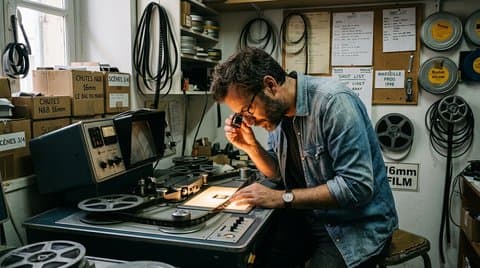
Cutting Celluloid in the Dark
The flatbed Steenbeck six-plate editing table hums at fifty cycles per second, a low mechanical drone that vibrates through the soles of your boots in this basement workshop off the Rue de la République in Marseille. When you switch on the optical viewer, a forty-watt tungsten bulb illuminates a six-inch frosted glass plate, and the room smells of warmed machine oil, acetate base, and the sharp chemical bite of acetone solvent.
On this table, editing is not a sequence of keystrokes. It is an irreversible physical act performed with razor blades, white china grease pencils, and cast-iron guillotine splicers. When you cut a strip of sixteen-millimeter negative, those twenty-four frames of photochemical emulsion are severed from the roll. If you change your mind forty minutes later, you cannot hit Command-Z. You must retrieve the cut frames from the cloth-lined trim bin, apply a droplet of film cement with a camel-hair brush, scrape off the emulsion layer with a steel blade, and weld the celluloid back together under the spring-loaded jaw of a press. Every mistake leaves a hairline scar on the screen—a faint black jump that announces to the audience that a human hand hesitated here.
Digital editing has murdered that hesitation. By offering infinite, cost-free reversibility, the modern non-linear timeline has eliminated the terror of the cut. And in eliminating the terror of the cut, it has drained cinema of its moral weight.
The Illusion of Infinite Options
In contemporary Hollywood and streaming production pipelines, a director sits before three calibrated forty-inch monitors while an assistant editor toggles between thirty-two takes of an actor walking across a kitchen. Because storage is virtually free and high-resolution cameras can roll continuously for ninety minutes without reloading, no one in the room is forced to make a decision during production. The phrase that has poisoned twentieth-century cinema—"We'll fix it in post"—is not a technical workflow; it is an abdication of artistic courage.
When shooting on sixteen-millimeter film with an old clockwork Bolex or an Arriflex SR2, a four-hundred-foot magazine gives you exactly eleven minutes of footage. At current lab prices for negative stock, chemistry development, and telecine scans, every second that ticks past the gate costs real money scraped together from small cultural grants and warehouse shifts.
The Discipline of Physical Scarcity: Finite Metrage → Intensive Rehearsal → Unified Spatial Tension → Decisive Authorship
When an actor knows the film in the magazine will run out in forty seconds, their performance changes. Their pupils dilate. The hesitation in their voice is not an algorithmic simulation of emotion; it is the genuine adrenaline of a human being operating under irreversible constraints. The entire crew breathes in sync with the motor. When the director calls "Cut," it is because the scene has achieved dramatic truth, not because the camera battery ran down.
Dimension | The Reversible Digital Timeline | The Physical 16mm Steenbeck Table |
|---|---|---|
Cost of the Cut | Zero cost, instant undo via keystroke | Irreversible material loss, physical scrape and weld |
Pacing Discipline | Bloated assembly cuts, deferred decisions | Ruthless spatial compression dictated by film length |
Material Texture | Uniform sensor grid, synthetic noise filters | Photochemical silver halide crystals and organic dust |
Sensory Atmosphere | Blue-white LED glare, quiet mouse clicks | Warm tungsten viewer, spinning reels, acetate smell |
Moral Weight | Indifference born of limitless alternatives | Consequence born of physical irreversibility |
The Geometry of the Single Room
The greatest cinema of the last century was not born from unlimited budgets; it was born from claustrophobia. Think of Robert Bresson's A Man Escaped, Chantal Akerman's Jeanne Dielman, or John Cassavetes' Faces. These films do not escape into external spectacle because they understand that human psychology becomes explosive only when contained within rigid spatial walls.
When you have only five thousand euros and two weeks to shoot an independent film, you do not write a script with helicopter chases or digital explosion plates. You put three actors in a single room with peeling wallpaper, place the tripod two meters from the table, and let the camera run until the emotional friction between them becomes intolerable.
[Spatial Confinement: 25m² Room]
│
├──> [Fixed 28mm Focal Length]
├──> [Natural Window Cross-Lighting]
└──> [Uncut Long Take on 16mm Emulsion]
In that confined geometry, every element matters. The sound of an enamel coffee pot clattering on a gas burner is not an audio effect dropped into a forty-track Pro Tools session; it is a physical event that bleeds into the dialogue microphone. You cannot edit around it, so you must accept it as part of the scene's biological reality.
The modern blockbuster has completely lost this sense of physical gravity. When characters interact in an environment constructed from green screens and Unreal Engine virtual sets, their eyes never truly focus on anything. They are looking at tennis balls on sticks, performing against invisible horizons. The resulting image may be technically flawless, but it possesses the nutritional value of distilled water. The human eye, which spent two million years deciphering the subtle cues of physical reality—the bounce of natural light off dusty floorboards, the micro-tremor of real muscle fatigue—registers the synthetic frame as a lifeless cartoon.
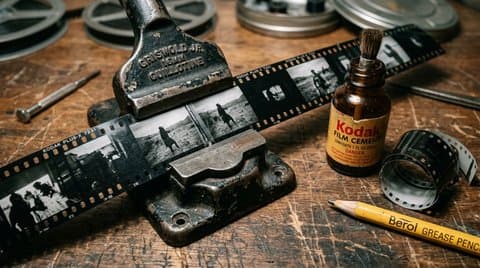 Vintage guillotine film splicer and celluloid negative on workbench
Scarcity as Vanguard
There is a growing myth among film school graduates that technology has "democratized" cinema because anyone can shoot a four-kilopixel video on an iPhone. But democratization without aesthetic discipline is merely inflation. What has actually happened is that the internet has been flooded with millions of hours of visually slick, dramatically hollow video content that vanishes from memory three seconds after the user swipes up.
True independent cinema does not compete with the streaming platforms on resolution or visual polish. It competes on truth. And truth is almost always found in what is withheld:
The Refusal to Move the Camera: When a scene is emotionally intense, moving the camera is often an act of cowardice. Lock the tripod. Force the audience to watch the character's face when they realize they have lost.
The Refusal to Over-Cut: A cut should feel like a sudden rupture in time, not a rhythm track to keep teenage viewers from looking away. If an actor can hold the scene for three minutes without a cut, let them hold it.
The Embrace of Grain: Photochemical grain is not an imperfection; it is the physical dance of silver halide crystals reacting to light. It gives the image a tactile skin that breathes in dark theaters.
The Resistance in the Basement
In this Marseille cutting room, as the autumn mist settles over the Old Port, the reels on the Steenbeck continue to turn. My fingers are black from film leader dust, and on the wooden desk lies a stack of yellow Kodak boxes containing twelve minutes of edited negative that took six weeks of deliberate labor to assemble.
Those twelve minutes will not be watched on a smartwatch while someone rides an escalator. They will be projected from a noisy Bell & Howell sixteen-millimeter projector in a community center with fifty wooden folding chairs, in front of seventy people who have come together in the dark to look at a beam of light passing through real celluloid.
Cinema does not need another twenty-million-dollar rendering farm. It does not need generative video software producing synthetic hallucinations of actors who died fifty years ago. Cinema needs five actors who have rehearsed until their voices are raw, twenty-five meters of physical film, and an editor sitting in the dark with a razor blade, terrified of making the wrong cut.